
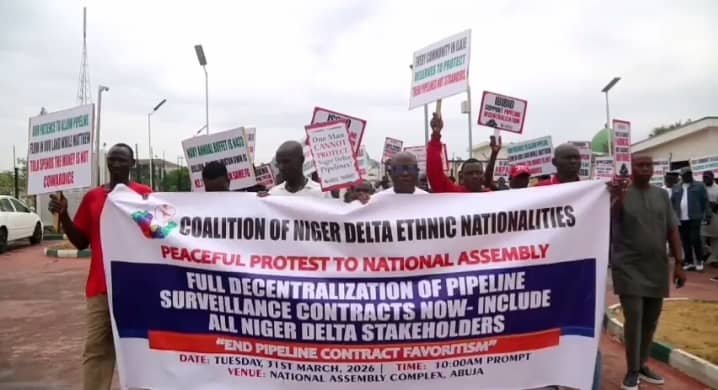
The Ijaw Youth Council (IYC), National Youth Council of Ogoni People (NYCOP), and other host community stakeholders have described their exclusion from National Assembly public hearing on pipeline surveillance contracts as unacceptable
The President of IYC, Dr. Theophilus Alaye in a statement issued Friday revealed that they were completely excluded despite being primary actors in pipeline protection.
Against this background,the groups staged a peaceful demonstration in Gokana Local Government Area, marching across major communities with placards to express their dissatisfaction and renew calls for the decentralisation of pipeline surveillance contracts.
Speaking during the protest, Alaye stressed that critical stakeholders cannot be sidelined in decisions that directly affect their communities.
He, therefore, called on the Presidency and the Office of the National Security Adviser to urgently intervene, noting that decentralising pipeline surveillance would empower host communities and significantly improve security outcomes.
Alaye pointed out that the host communities possess deep knowledge of the terrain, creeks, and local movement patterns, placing them in the best position to detect and prevent pipeline vandalism and crude oil theft.
He maintained that decentralisation would ensure faster response to security breaches, eliminate bureaucratic delays, and strengthen grassroots intelligence gathering across oil-producing areas.
Also, the President of the National Youth Council of Ogoni People, Marcus Nwibani explained that the protest was driven by the need for fairness, inclusion, and justice.
He cautioned that excluding host communities from key engagements erodes trust and weakens the fight against crude oil theft, adding that meaningful inclusion is critical to achieving sustainable results.
On his part, President of the Ogoni Youths Federation, Emmanuel Bie decried continued marginalisation of Ogoni people despite decades of oil exploration in the region.
He was of the opinion that the inclusion of host communities remained the most effective and sustainable solution to combating crude oil theft and ensuring lasting peace and stability in the Niger Delta.
He noted that Ogoniland hosts over 40 oil wells, yet indigenous participation in pipeline surveillance remains significantly low.
Bie added that involving host communities directly would foster a sense of ownership, reduce sabotage, and enhance accountability, as communities are more likely to protect infrastructure that benefits them.