
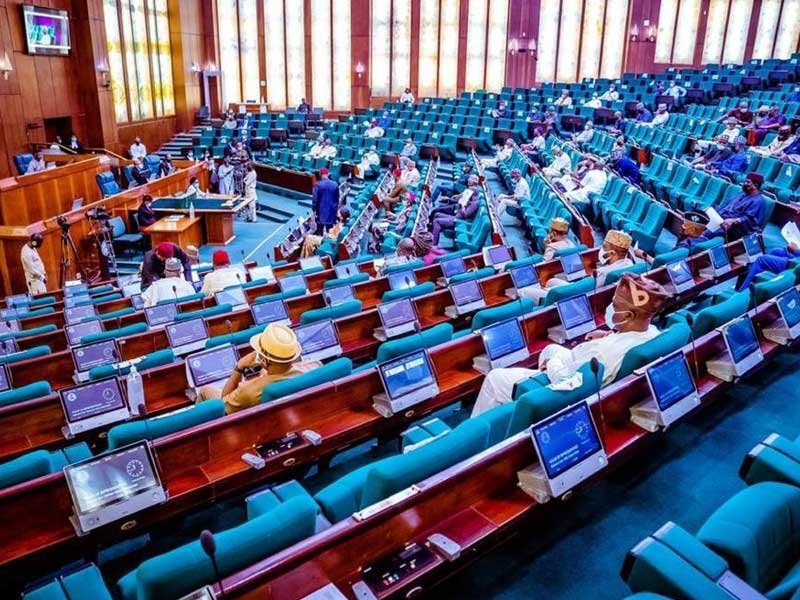
The House of Representatives has declared that the ad-hoc committee on altered tax law constituted by the Minority Caucus of the House lacked institutional recognition.
It added that no political caucus, whether majority or minority, possesses the procedural authority to establish a committee that carries the status of a parliamentary body.
The Green Chamber said it considered the action attributed to the minority caucus to be procedurally improper, inconsistent with parliamentary norms, liable to set an unwholesome precedent, and to create unnecessary public confusion, particularly since the matter has already been addressed through established parliamentary mechanisms.
TheHintsNews reports that the Minority Caucus had on January 2, 2026 constituted an ad hoc committee to further examine the recently enacted tax laws, and that the said body has reportedly submitted an interim report.
However, the Minority in its interim reports released last Friday insisted that the Nigeria Tax Administration Act (NTAA) 2025, has a number of discrepancies from the version passed by the National Assembly and the version earlier published in the official gazette.
But the spokesperson of the House, Hon. Akin Rotimi in a statement issued Sunday said while the House recognised the legitimate role of the minority caucus within parliamentary democracy and affirmed its right to express dissenting opinions, engage in policy advocacy, and raise public concerns, it was necessary to clearly distinguish between political activities and the formal parliamentary processes of the House.
He pointed out that under the Standing Orders of the House of Representatives (Eleventh Edition), the authority to constitute an ad hoc committee of the House rests solely with the House acting in plenary, or with the Speaker exercising powers conferred under the Standing Orders.
Rotimi noted: “No political caucus, whether majority or minority, possesses the procedural authority to establish a committee that carries the status of a parliamentary body.
“Political caucuses remain important platforms for consultation and coordination among Members.
“However, they do not possess institutional authority within the House and do not possess investigative authority, oversight jurisdiction, or the power to summon persons or demand official documents.
“Any action taken by a caucus in this regard is therefore non-binding, informal, and without legal or institutional consequence.
“Any committee constituted outside the processes prescribed by the Standing Orders lacks institutional recognition.
“Accordingly, any interim or final report emanating from such a caucus-led body cannot be laid before the House, cannot be received as a parliamentary document, and does not form part of the official legislative or oversight record of the National Assembly.”
He recalled that in December 2025, the House duly constituted a bipartisan ad hoc committee following the intervention of an opposition member who formally drew the attention of the House to the existence of multiple documents purporting to be official gazettes of the tax legislation.
The spokesperson stressed that the mandate of that committee, which comprised members from both the ruling and opposition parties, is specifically to examine those allegations.
He noted that the committee was constituted by the House in line with the Standing Orders, remains in force, and continues to discharge its assignment.
Rotimi said upon the conclusion of its work, it would lay its report before the House in plenary.
“Subsequently, the National Assembly, acting jointly through both Chambers, published the official Gazette of the National Assembly and issued Certified True Copies of the enacted tax laws. The legislative process has therefore been concluded and given full legal effect,” he said.
Rotimi emphasised that the National Assembly has also formally disowned and debunked any unofficial documents in circulation, reiterating that only the gazetted versions and duly certified copies issued by the National Assembly constitute authentic legislative instruments.
He stated: “In this context, the establishment of a parallel caucus-led committee and the circulation of purported interim findings serve only to compound public misunderstanding on an issue that has been institutionally resolved and overtaken by events.”