
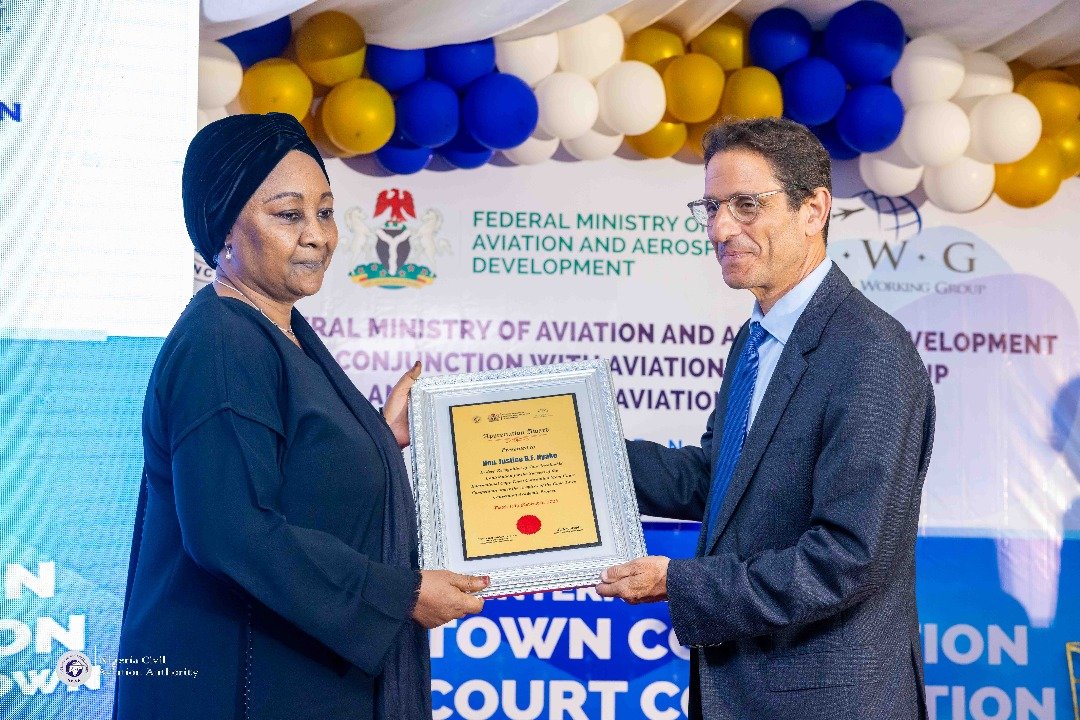
Authority (NCAA) called for the support of the judiciary to deepen the understanding of laws governing contractual dealings in the nation’s aviation sector, particularly the Cape Town Convention (CTC).
TheHintsNews reports that the CTC comprises the Cape Town Convention on International Interests in Mobile Equipment 2001 and the Protocol to the Convention on Matters Specific Aircraft Equipment.
The Director-General, Capt. Chris Najomo made the call at the grand finale of the international CTC moot court, held at the Federal High Court in Abuja under the auspices of the CTC Academic Project.
Najomo, who was represented by the Director, Operations, Licensing and Training, NCAA, Capt. Donald Spiff, said the CTC has put Nigeria in a better perspective to aircraft lessors and general aviation business in Nigeria.
He noted that the purpose of the programme is to familiarise students, academics and judges with the CTC in the context of complex hypothetical fact patterns, and provide students with educational exercises involving these instruments (CTC) in a simulated judicial setting.
Spiff stressed that before now, most airline manufacturing or leasing companies did not want to conduct business in Nigeria, adding that with the CTC, assurances have been given.
Najomo added: “Through the efforts of the Honourable Minister of Aviation and Aerospace Development, Mr. Festus Keyamo SAN, we are now in the good books of these organisations.
“And, this is an enlightenment programme to tell the world that we have arrived and we are ready to do business,” he said.
Najomo hailed the performance of the students, who participated in the programme and commended them for their display of brilliance and commitment, noting that it shows the country’s capacity in every sector.
The Secretary General of the AWG and Co-Director of the CTC Academic Project, Jeffrey Wool, said he was thrilled by the first Nigerian international CTC moot court.
Wool said the CTC is a very important international treaty, ratified by Nigeria, adding that the moot court was a way to introduce students and the legal system to this all important treaty and further familiarise the court with the provisions of the treaty.
He said the CTC is very important economically to the country, and noted that the Federal High Court recently out in place a practice direction on how to address CTC related cases.
The event featured the simulation of a real court experience, involving two opposing legal teams made up of Law students drawn from the University of Benin and the University of Lagos.
The moot court was held under the supervision a three-member panel of judges of the Federal High Court, Abuja – Justices Binta Nyako (who presided), Joyce Abdulmalik and James Omotosho.
The Nigerian moot court competition saw 18 universities, drawn from all the nation’s six geopolitical zones, participating in the preliminary round.
The University of Benin and University of Lagos, which competed at the final held on November 12, emerged as the two overall best from the preliminary round.