
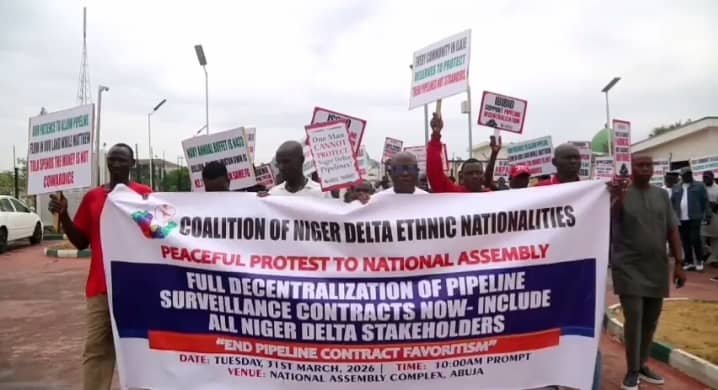
The Coalition of Niger Delta Ethnic Nationalities (CNDEN) Tuesday stormed the National Assembly demanding urgent decentralisation of pipeline surveillance contracts to Niger Delta stakeholders across all oil-producing states.
The coalition in a petition to the President of the Senate, Godswill Akpabio was jointly signed by the President-general of the coalition and President, Ijaw Youth Council (IYC), Dr. Alaye Theophilus, President, Ibom Youth Council, Mammoth Knight and President, Ogoni Federated Youth, Emmanuel Bieh, among others.
Addressing journalists during the protest, Alaye said the region remained the economic backbone of Nigeria, hosting the oil and gas resources that generate the bulk of the nation’s revenue.
Consequently, he noted that the protection of pipeline infrastructure was not only a regional concern but a critical national security priority.
Alaye stated categorically that the petition was not targeted against any specific company, including Tantita Security Services Nigeria Limited, Maton Engineering, pipeline Infrastructure Limited, nor was it aimed at discrediting the efforts of any existing pipeline surveillance contractor,
His words: “Rather, this petition is driven by the urgent need to correct a structural imbalance in the current pipeline surveillance framework, where responsibilities appear to be concentrated in the hands of a few individuals or entities, to the exclusion of the wider Niger Delta stakeholders and ethnic nationalities.”
Alaye expressed concern that the current centralised structure of pipeline surveillance contracts excluded critical stakeholders and host communities across the Niger Delta states.
This, he said, encouraged unhealthy competition and division among ethnic nationalities, fuels grievances, marginalisation, and growing resentment among stakeholders.
Alaye emphasised that it also weakened grassroots intelligence necessary for effective pipeline protection.
He added: “More troubling is the emergence of a growing cold war among stakeholders and exagitators in the Niger Delta, largely driven by perceived exclusion and inequitable distribution of opportunities tied to pipeline surveillance.
“If not urgently addressed, this situation poses a serious risk of escalating into open conflict, which could result in widespread vandalism of oil and gas infrastructure and further destabilize the region.”
Alaye recalled that during the peak of militancy in the Niger Delta, Nigeria’s crude oil production averaged 2.0 – 2.1 million barrels per day.
He stressed that today, despite relative peace and the commitment of billions of Naira to pipeline surveillance, production remains between 1.5—1.7 million barrels per day, saying this contradiction raises serious national concerns.
Alaye queried: “Why is oil production declining despite increased spending on pipeline security? e Are there systemic lapses or undisclosed networks facilitating crude oil theft?
“Is the current surveillance structure truly effective or fundamentally flawed?
“The Coalition submits that the exclusion of local stakeholders from active participation is a major factor undermining the effectiveness of pipeline protection efforts.”
In view of the above, the coalition strongly advocated for the full decentralization of pipeline surveillance contracts such that each Niger Delta state is allocated surveillance responsibilities within its territory.
The Coalition assured the federal government that decentralisation would result in significant increase in crude oil production, with potential growth toward 2.8 – 3.0 million barrels per day.
It noted that it would enhance intelligence gathering and rapid response capability at the community level, as well as drastic reduction in oil theft and pipeline vandalism.
Alaye said: “We reiterate that this petition is not an attack on any individual or organization but a collective call for justice, fairness, and inclusivity.
“We firmly assure the Federal Government that if pipeline surveillance contracts are fully decentralized to stakeholders across all Niger Delta states, oil production will increase significantly, and the current tension among stakeholders will be effectively doused.
“The Niger Delta cannot afford a return to instability. Nigeria, at this critical time, cannot sustain another phase of conflict in the region.
“The present situation, if not urgently addressed, may degenerate into a crisis with far-reaching consequences for national security and economic survival.
“The Coalition therefore urges the National Assembly, the Office of the National Security Adviser, and all relevant security agencies to act swiftly, decisively and fairly in the interest of national unity, economic growth, and sustainable peace.”