
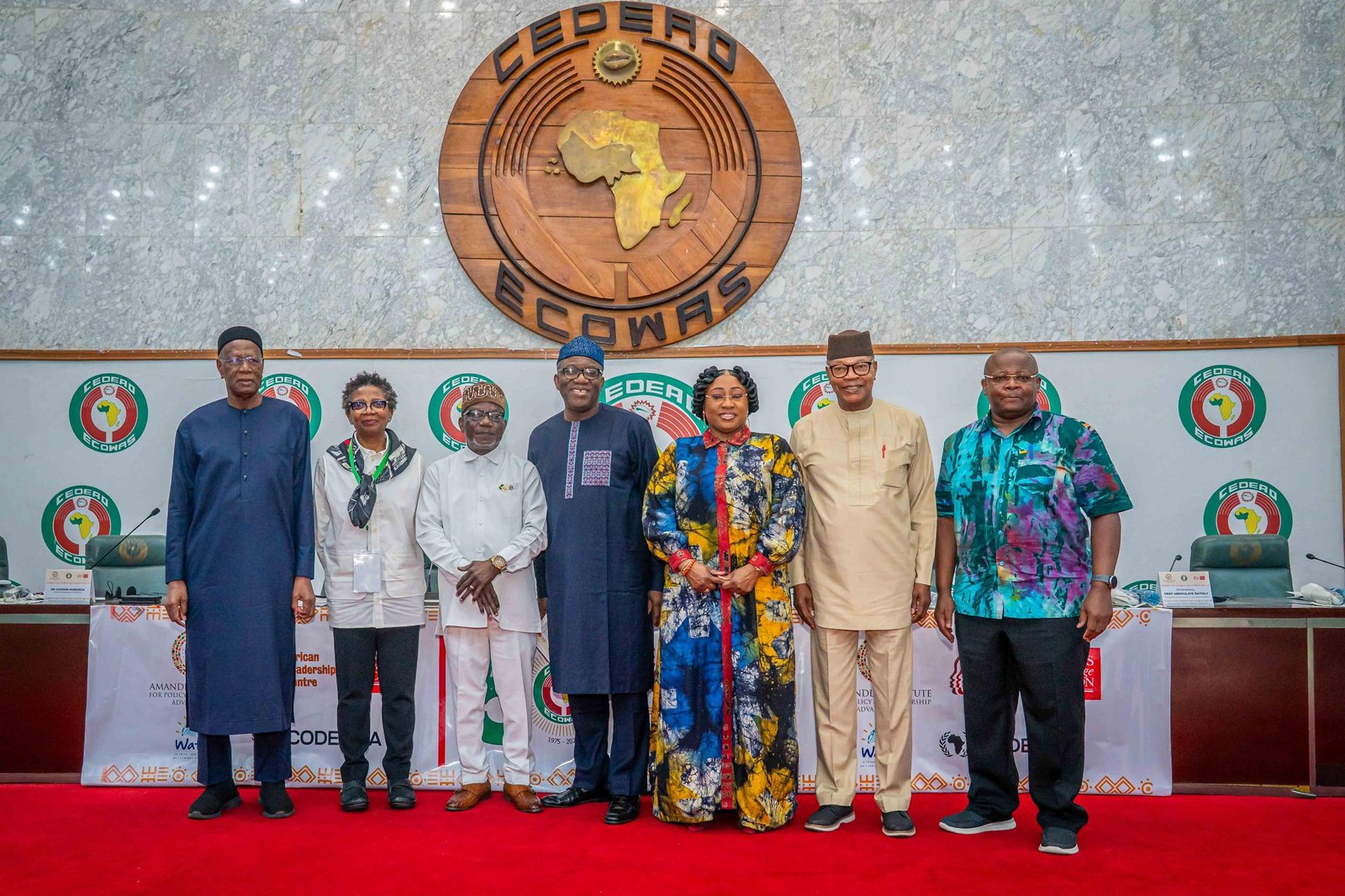
Former Ekiti State Governor, Dr. Kayode Fayemi has called for urgent reform of Economic Community of West African States (ECOWAS) to be able to tackle the myriad of challenges facing the sub-region.
He made the call on in Abuja at the second edition of the African Political Square and the Experts meeting on Alternative Futures for ECOWAS at 50; jointly organized with the African Leadership Centre (ALC), in collaboration with Codesria and Wathi.
Fayemi noted that the challenges of poverty, inequality, governance deficits, insecurity and others in the West African region cannot be effectively addressed by the regional bloc in its current form without the application of systematic reform.
“Clearly, the current state of the regional body underscores the need for deep reflection on how ECOWAS can move beyond being an elite-driven institution to one that truly represents and serves its people.
“The challenges of poverty, inequality, governance deficits, and insecurity cannot be effectively addressed by ECOWAS in its current form.
“There is an urgent need for a new, citizen-centered approach that responds to the real concerns of ordinary West Africans, rather than focusing solely on the priorities of political leaders,” Fayemi, who is the co-founder of Amanda Institute for Policy and Leadership Advancement, said.
He noted that traditional military strategies alone are inadequate in tackling the complex threats posed by insurgent and terrorist groups.
He said, “Many of these groups are deeply embedded within communities and even, in some cases, within the military itself.
“What is needed is a more sophisticated intelligence-based approach, combined with efforts to address the underlying social and economic drivers of insecurity.
“We need a comprehensive human security strategy that deals with issues of poverty, inequality, and governance failures, which extremist groups continue to exploit.
“While it is understandable that many citizens are frustrated with civilian governments that have failed to deliver on governance and security, we should also not mince words that military rule is not a viable alternative in tackling governance deficits.
“History has shown that military regimes do not provide sustainable solutions. In fact, in the three countries that have now exited ECOWAS, terrorism and insecurity have worsened since the military took over.”
He tasked the ECOWAS leadership to get a working arrangement with AES countries.
Fayemi added: “The challenge for ECOWAS is how to engage these regimes while also ensuring a pathway back to credible democratic governance.
“It is crucial that ECOWAS continues to leverage diplomatic efforts in finding pragmatic ways that do not alienate the breakaway states further but instead brings them back into a cooperative regional framework.
“The current effort of the Commission in this regard is noted. In this regard, ECOWAS has always been a flexible and adaptive regional body, accommodating different sub-regional groupings like UEMOA, CENSAD, the Mano River Union, and others.
“There is no reason why AES (the putative Sahelian bloc of Burkina Faso, Mali, and Niger) cannot continue to be part of ECOWAS, even if they insist on maintaining a distinct identity. The goal should be to preserve regional cooperation, stability, and development, rather than encouraging further divisions.”
Fayemi was of the opinion that all the issues confronting the region collectively reinforce the urgency of rethinking and reimagining ECOWAS’s role in a changing West Africa.
On her part, the Vice President (International Engagement) at King’s College London and Founding Director of the African Leadership Centre, Prof. Funmi Olonisakin, said the 50th anniversary of ECOWAS should provoke a fundamental rethink of the regional body’s purpose and structure.
“Even without the current crises, a strong case exists for a reinvention of the West African integration project. The transition from an ECOWAS of rulers — an elite club of political leaders — to a community of the people has not happened as hoped,” she said.
Also, the ECOWAS Commission President, Dr. Omar Touray lamented that the regional bloc today faces a crisis of democracy and security.
Touray, represented by the Commissioner for Political Affairs, Peace and Security, Ambassador Abdufatah Musah, said the moment is one demanding deep introspection and honest self-assessment.