
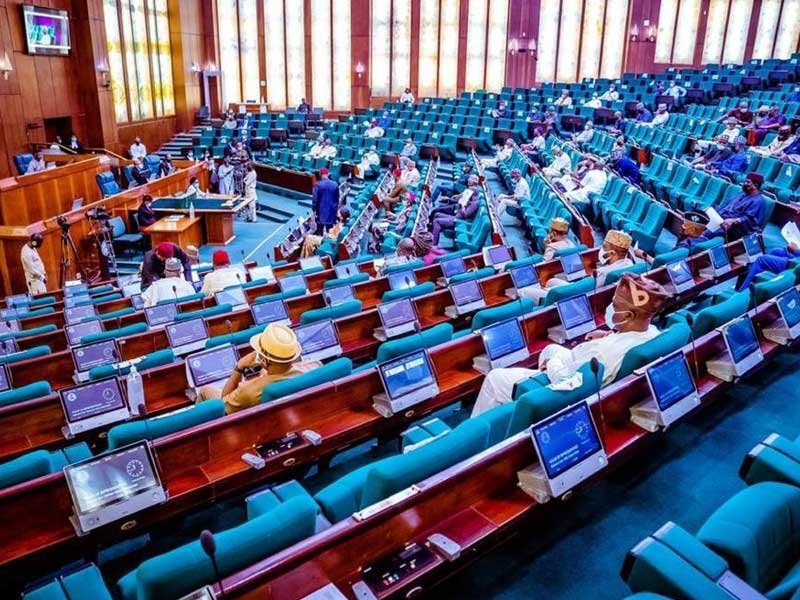
The House of Representatives has rejected outrightly the narratives by the US lawmakers that frame Nigeria’s security crisis as a religious conflict or as State-sponsored persecution.
To this end, the Green Chamber mandated its Committees on Foreign Affairs, National Security, & Intelligence, Interior, and Information, National Orientation and Values , police affairs, civil society, human rights to within 21 days coordinate the Federal Ministry of Foreign Affairs and the Nigerian Embassy in Washington, D.C. to lodge a formal diplomatic demarche to the sponsors of S.2747 and relevant U.S. committees, transmitting empirical data and Nigeria’s official position;
The resolution of the House followed the adoption of a motion moved at the plenary on Wednesday by the Deputy Speaker, Hon. Ben Kalu in response to the Proposed Nigeria Religious Freedom Accountability Act of 2025 (U.S. Senate Bill S.2747) and to Mischaracterisations of Nigeria’s security and religious-freedom landscape.
Moving the motion, Kalu recalled that on 9 September, 2025 a bill titled the Nigeria Religious Freedom Accountability Act of 2025 (S.2747) was introduced in the United States Senate seeking to require the U.S. Secretary of State to designate Nigeria a Country of Particular Concern (CPC) and to impose sanctions on Nigerian officials under Executive Order 13818 (Global Magnitsky) and related authorities.
He added that the U.S. Commission on International Religious Freedom (USCIRF) has in recent annual reports recommended Nigeria for CPC designation, citing persistent violations and state failures to protect against non-state actor abuses.
The Deputy Speaker explained that Nigeria’s Constitution guarantees freedom of thought, conscience and religion and bars adoption of a State religion, and that successive administrations, security agencies, faith leaders and civil society continue to undertake measures to protect all worshippers and prosecute offenders, as reflected in the U.S. Department of State’s 2023 country chapter and prior reports.
He noted that insecurity in Nigeria is complex and multi-causal – driven by insurgency, criminal banditry, farmer-herder conflict, separatist violence and communal disputes – affecting citizens of all faiths; international reporting attributes a significant share of fatalities to terrorist groups and criminal gangs rather than State policy or a single religious dynamic.
Kalu expressed concern that external legislative actions based on incomplete or decontextualised assessments risk undermining Nigeria’s sovereignty, misrepresenting facts, straining strategic relations, and unintentionally emboldening violent actors.
The House, however, condemned all forms of violence and persecution against any person or group on the basis of religion or belief and commiserates with all victims irrespective of faith.
It resolved: “Rejects outrightly narratives that frame Nigeria’s security crisis as a singularly religious conflict or as State-sponsored persecution, and reaffirms Nigeria’s constitutional protections for freedom of religion and belief.”