
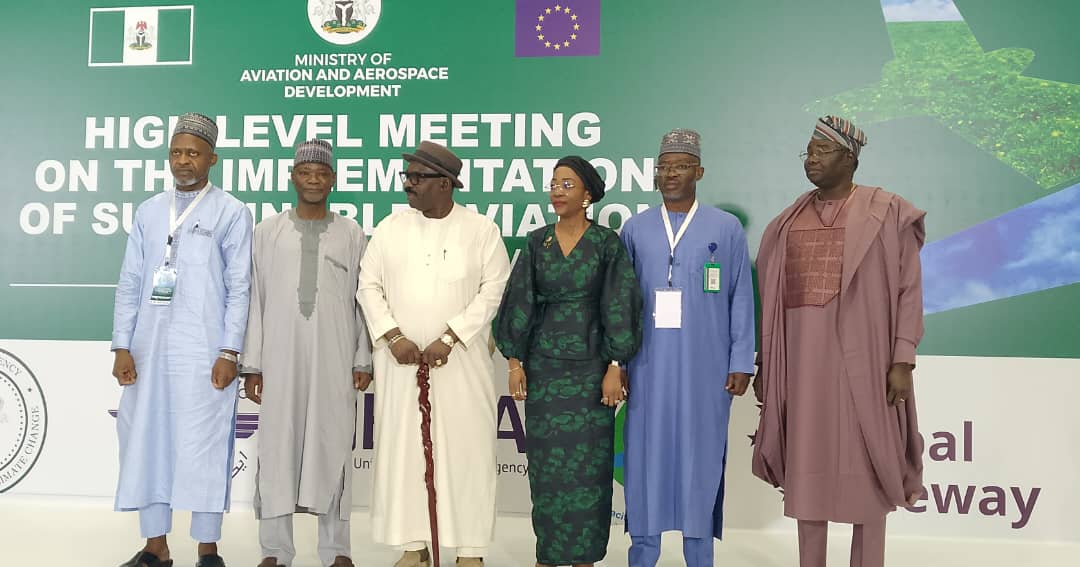
The federal government has inaugurated a seven-man high-level Sustainable Aviation Fuel (SAF) steering committee to decarbonise its aviation sector.
This committee, it said, would serve as a national governance platform responsible for providing strategic direction, coordinating implementation, promoting collaboration among stakeholders, and overseeing the delivery of Nigeria’s Sustainable Aviation Fuel Implementation Programme.
The Minister of Aviation and Aerospace Development, Festus Keyamo, speaking during the presentation of the National Sustainable Aviation Fuel Feasibility Study, and the launch of the ICAO-supported Sustainable Aviation Fuel Business Implementation Study hinted that Sustainable Aviation Fuel (SAF) represents one of the most practical and impactful pathways towards achieving this objective.
Keyamo stated that SAF offers an opportunity not only to decarbonise aviation but also to stimulate investment, create new industries, generate employment, strengthen energy security, and unlock enormous value across Nigeria’s agricultural, energy, and industrial sectors.
According to him, As global efforts to address climate change intensify, aviation must also contribute meaningfully towards reducing greenhouse gas emissions while enhancing air connectivity that supports the growth of our national economy.
Keyamo noted: “As the largest producer of cassava in the world, with a vibrant agricultural economy that generates vast quantities of agricultural and industrial residues, growing human and technical capacity, expanding domestic processing capability, and a strategic geographic location, our country is well positioned to become a major producer and supplier of sustainable aviation fuel for Africa and beyond.
“The Sustainable Aviation Fuel Feasibility Study, which will be formally handed over today, represents an important body of knowledge.
“It provides Nigeria with a sound technical assessment of our opportunities, challenges, and comparative advantages, and serves as a solid foundation upon which we can build our national implementation programme.”
Continuing, Keyamo said the transition to sustainable aviation fuel is not the responsibility of one ministry or one institution alone.
He stressed that it requires coordinated and cross-cutting action from government, industry, academia, financial institutions, development partners, and the private sector.
Keyami added: ” One of the most important outcomes of today’s event is the formal inauguration of the Nigeria Sustainable Aviation Fuel Steering Committee.”
The minister called on every member of this committee to approach this assignment with dedication, innovation, and a shared sense of national purpose.
“Our work must translate policy into action, research into investment, and opportunities into measurable national development,” he said