
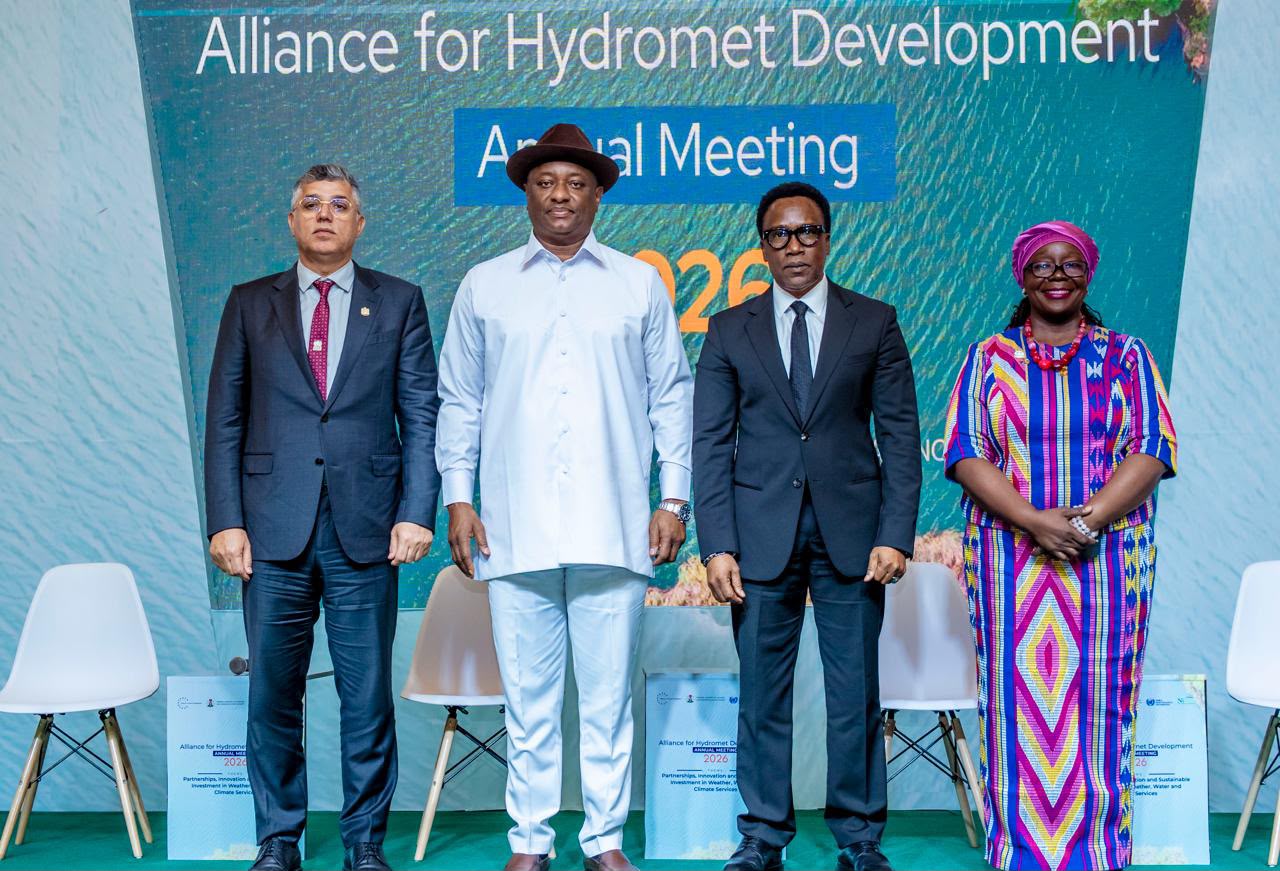
The Director-General of the Nigerian Meteorological Agency (NiMet), Prof. Charles Anosike ane Permanent Representative of Nigeria with the World Meteorological Organisation (WMO) and the President of World Meteorological Organisation (WMO), Dr. Abdulla Al Mandous have called for increased investment in weather and climate observation infrastructure and stronger public-private partnerships to address critical data gaps across Africa.
Anosike made at the 2026 Annual Meeting of the Alliance for Hydromet Development, held at Eko Hotel & Suites, Lagos.
Highlighting Africa’s observation challenges, Anosike stated that Africa today has the largest basic weather and climate data gaps in the world, holding roughly 30 per cent of the global observation deficit.
He added that the continent has only about 12.5% of the minimum weather station density recommended by WMO, with compliance rates of just 7% for surface land stations and 9% for upper-air stations across 53 African countries.
Anosike called for increased investment in observation infrastructure, remote sensing, analytics and data platforms, noting that government funding alone cannot meet the growing needs.
He also highlighted NiMet’s contributions to aviation safety, agriculture, maritime operations and disaster risk management, emphasising the importance of translating weather information into actionable guidance and strengthening early-warning systems.
Also, Al Mandous also called on Nigeria and other African countries to increase investment in meteorological and hydrological services to strengthen early warnings, protect lives and livelihoods, and support sustainable economic development.
He described the period leading to 2030 as critical to closing capacity gaps in weather and climate services.
Commending Nigeria’s growing contribution to regional cooperation, Al Mandous noted that the country had moved from being a beneficiary of technical support to sharing expertise with other countries, including supporting Burkina Faso as a peer reviewer under the Country Hydromet Assessment initiative.
He urged governments and development partners to prioritise investment, strengthen institutional frameworks, expand partnerships with key economic sectors and promote regional cooperation.
He stated: “Our direction is clear: to turn assessments into investments, investments into lasting capacity, and early warnings into early action that saves lives and livelihoods.”