
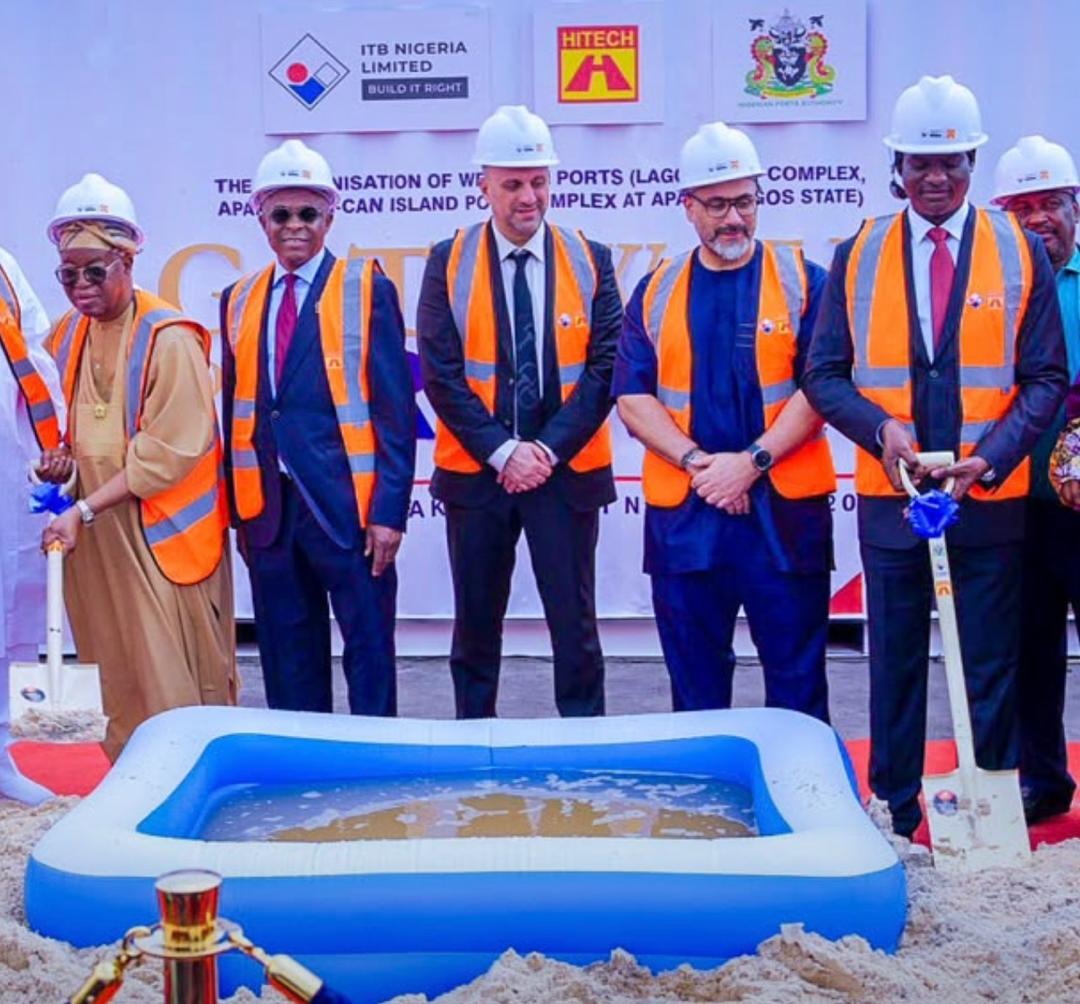
The federal government Wednesday flagged off the modernisation and upgrade of the Lagos Port Complex, Apapa, and Tin Can Island Port.
The Minister of Marine and Blue Economy, Adegboyega Oyetola, supported by the Minister of Finance and Coordinating Minister of the Economy, Mr Taiwo Oyedele, and other senior government officials described the project as a strategic investment that would reposition Nigeria as a leading maritime hub in Africa and strengthen the country’s competitiveness in global trade.
Oyetola stressed that the project, which would cost £746 million (approximately ₦1.45 trillion), would address decades of infrastructure deficits, reduce logistics costs, attract international shipping lines, stimulate industrial growth and create at least 20,000 direct and indirect jobs.
He said the modernisation programme is a significant step towards realising President Bola Tinubu’s Renewed Hope Agenda, which prioritises infrastructure development as a catalyst for economic growth, investment and job creation.
Oyetola added: “The two ports, which have served as major gateways for Nigeria’s international commerce for decades, have become increasingly inadequate to meet the demands of a rapidly expanding economy and changing global shipping requirements.”
The minister in a statement issued by his Special Adviser, Bolaji Akinola, noted that Apapa Port, established in 1913, was more than a century old, while Tin Can Island Port was commissioned in 1977 when Nigeria’s population stood at approximately 67.2 million, annual trade was about $17 billion and cargo throughput was 8.11 million metric tonnes.
Today, he said, Nigeria’s population has grown to approximately 240 million, merchandise trade exceeds $100 billion annually, while cargo throughput has increased to 129.3 million metric tonnes, nearly 16 times its 1977 level.
Oyetola stressed that the mismatch between growing economic activities and ageing port infrastructure had made comprehensive modernisation both urgent and unavoidable.
He stated: “The cost of inaction is far greater than the cost of modernisation,” adding that Nigeria will not surrender its competitive advantage.
“Our ambition is to attract more direct calls by international shipping lines, retain Nigerian-bound cargo, expand transshipment opportunities and establish our ports as preferred gateways to trade across the African Continental Free Trade Area.
” We cannot achieve this ambition with infrastructure that falls behind the demands of modern shipping,” the Minister said.
Oyetola lamented that cargo dwell time at Nigerian ports had historically ranged between 10 and 18 days, compared with three to five days at leading international ports, resulting in congestion, demurrage, storage charges and higher logistics costs.
These inefficiencies, he said, were estimated to cost the Nigerian economy as much as $4 billion annually.
He warned that Nigeria could no longer afford to lose maritime business to neighbouring countries, which have invested in deep-sea port infrastructure and modern cargo-handling facilities to attract international shipping and transshipment traffic.
Oyetola stated: “The project will entail the comprehensive rehabilitation and upgrading of critical port infrastructure, including quay walls and berths, dredging and navigation channels, access facilities, cargo-handling equipment and operational systems.
“It will address longstanding physical constraints while advancing more integrated, efficient and digitally enabled port operations.”
He projected that the project would generate at least 20,000 direct and indirect jobs across construction, engineering, dredging, logistics, transportation, port operations and related services.
Speaking, Oyedele described the modernisation programme as a major step towards reducing the cost of doing business, strengthening the country’s competitiveness and accelerating economic growth.
He noted that more efficient port operations would reduce delays and associated costs for importers and exporters, improve the competitiveness of Nigerian goods and deliver wider benefits to manufacturers, farmers and consumers.