
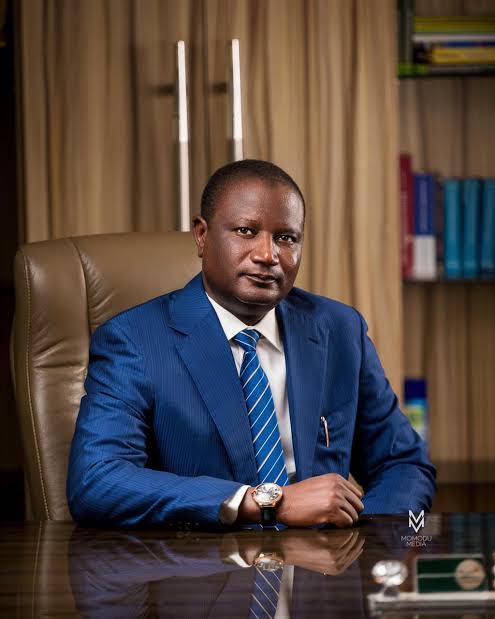
A Federal High Court, Lagos has ordered the enforcement of a $40 million judgement debt dispute linked to the Chairman of the Rahamaniyya Group of Companies, Abdulrahman Bashar.
TheHintsNews reports that the enforcement action followed a 25 February, 2026 order of the Federal High Court, Lagos Judicial Division, granting Petrichor Energy FZCO leave to register a judgment of the High Court of Justice of England and Wales and registering that judgment for purposes of enforcement in Nigeria.
The Court subsequently issued writs of attachment and sale dated 15 May, 2026 directing enforcement against assets belonging to Bashar and, under a separate writ, Bashar and Ultimate Oil & Gas FZCO.
The enforcement operation was carried out with enforcement documents served and posted at properties connected to the respondents.
Background
An English court had in May 2926 ordered the freezing of Bashar’s holdings across at least four countries after he failed to satisfy a $40 million judgment debt and allegedly threatened to spirit away his wealth rather than pay what he owes.
The High Court in London granted a worldwide freezing order on March 30 against Bashar and his UAE-registered trading vehicle, Ultimate Oil and Gas FZCO, following what the court described as a pattern of evasion, incomplete disclosure, and deliberate asset movement designed to place his fortune beyond the reach of creditors.
The order, one of the most powerful remedies available under English law, bars Bashar and his company from disposing of or dealing with any assets anywhere on the globe up to the value of the outstanding debt.
His disclosed holdings, spanning the United Arab Emirates, Nigeria, the United Kingdom, and France, were valued at close to $170 million as of the date the order was made.
The dispute has its roots in a series of oil trading deals struck between 2022 and 2023. Petrichor Energy FZCO, a Dubai-based commodity trading house, entered into spot and term contracts with Ultimate Oil and Gas for the supply of gasoil and Jet-A1 aviation fuel.
According to court documents, Ultimate received the cargoes but repeatedly failed to make full and timely payment, leaving Petrichor out of pocket and forcing the company to pursue recovery through simultaneous court and arbitration proceedings.

Seeking to draw a line under the dispute, Bashar signed a personal payment agreement in January 2024, backing it with a personal guarantee that made him individually liable for Ultimate’s debts if the company failed to pay.
He also handed over nine signed, undated cheques as additional security. Both instruments would prove worthless in practice. Ultimate never fully settled the debt, and when Petrichor presented the cheques, Bashar’s bank rejected every one of them.
By February 2025, the English court had entered judgment against both Bashar and Ultimate. Approximately $40 million remains outstanding.
As Petrichor pushed toward enforcement, it found its path blocked at every turn, and the manner in which it was blocked alarmed the court.
Judges reviewing the application for a freezing order found that Bashar had sold multiple UAE properties worth roughly $3.8 million shortly after the English judgment was handed down, without directing any of those proceeds toward the debt.
More damaging still was testimony about a phone call on March 15 this year. According to evidence accepted by the court, Bashar told Petrichor’s managing director that if the creditor refused yet another revised repayment proposal, he would “dispose of” his assets to make enforcement harder. The court treated that threat as direct evidence of a risk that assets would be dissipated.
The picture was further complicated by questions over what Bashar had actually disclosed. Evidence before the court indicated that Nigerian assets, including petrol stations and a residential property reportedly worth more than $21 million, had not been included in earlier asset declarations.
The omission deepened concerns that the trader was concealing the full scope of his wealth. Presiding over the application, the judge concluded that this appeared to be a case of someone who “will not pay, rather than cannot pay.”