
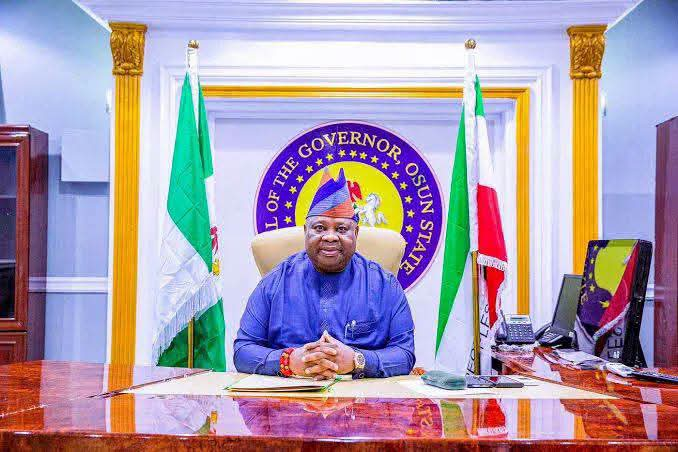
The drums of celebration have sounded, political campaigns have given way to governance, and the people of Osun State have once again entrusted their future to Senator Ademola Adeleke. On Friday, November 27, 2026, Governor Adeleke was officially sworn in for a second term, marking the beginning of another four years of leadership and responsibility.
The inauguration, held at the Osogbo Township Stadium, was more than a ceremonial event. It represented the renewal of a democratic mandate, a fresh opportunity to consolidate achievements, correct shortcomings and pursue a more ambitious development agenda for the state.
Having secured re-election in the August 15, 2026 governorship election with 511,067 votes, defeating his closest challenger, Asiwaju Munirudeen Bola Oyebamiji of the All Progressives Congress, Adeleke has received another opportunity to demonstrate that the confidence reposed in him by the electorate was not misplaced.
Osun State Governor, Ademola Adeleke, on took the oath of office to officially commence his second term in office for the next four years. The oath was administered to the governor by the state Chief Judge, Mrs. Adepele Ojo.The swearing-in ceremony, which started around 11:35 am, ended at 11:39 am.
Earlier, the Deputy Governor, Kola Adewusi, had taken the oath of office around 11:20 am.
The Vice-President of the Federal Republic of Nigeria, Alhaji Kashim Shettima and former Osun State Governor, Chief Adebisi Akande, were among those in attendance as Adeleke arrived at Osogbo Township Stadium for the commencement of his second-term inauguration today.
Top officials of the Osun State Government had earlier arrived at the venue.The Speaker of the House of Assembly, Rt. Hon. Adewale Egbedun, and the Secretary to the State Government, Alhaji Teslim Igbalaiye, were among the first set of dignitaries to arrive at the venue.
Also in attendance were former Senate President Bukola Saraki; former deputy governors Iyiola Omisore, Olusola Obada and Benedict Alabi; the Soun of Ogbomosoland, Oba Ghandi Afolabi Olaoye, the Alaafin of Oyo, Oba Akeem Owoade; the Olubadan of Ibadan, Oba Rasidi Adewolu Ladoja, and the Peoples Democratic Party National Treasurer, Diran Odeyemi, among others.
But beyond the excitement, political endorsements, colourful displays and congratulatory messages lies a more fundamental question: What does a second term mean for the ordinary people of Osun State?
The answer must go beyond political rhetoric. It must be reflected in better living conditions, economic opportunities, quality infrastructure, accessible healthcare, improved education, security and a government that genuinely responds to the needs of its citizens.
A second term is often regarded as a period of consolidation. Unlike the first term, which may be characterised by the need to establish administrative structures, introduce policies and demonstrate leadership direction, a second term offers an incumbent governor the opportunity to deepen reforms, strengthen institutions and deliver more measurable results.
For Adeleke, the task ahead is particularly significant. His administration must move beyond the politics of winning elections to the business of winning the confidence of all citizens, including those who did not vote for him.
The governor’s inaugural address has already provided some indications of his priorities. He expressed his determination to transform Osun from a predominantly civil-service-dependent economy into an industrialised state through agro-processing, industrial parks, free trade zones, tourism, sports development and an improved business environment.
This is an ambitious vision, but its success will depend on effective implementation. Osun possesses considerable agricultural potential, a rich cultural heritage, mineral resources, educational institutions and a youthful population. These assets should not remain dormant. They must be converted into productive economic opportunities capable of generating employment, attracting investments and improving the state’s internally generated revenue.
The establishment of industries and agro-processing facilities across the state’s geographical zones could create opportunities for farmers, artisans, entrepreneurs and young graduates. What the people expect is not simply the announcement of investment projects but their actual implementation and sustainability.
One of the major challenges confronting Osun is the need to build a productive economy that does not depend excessively on federal allocations and the civil service. While the payment of workers’ salaries and pensions remains an important responsibility, sustainable development requires a broader economic framework.
The second-term administration should therefore prioritise support for small and medium-scale enterprises, encourage private-sector investment, strengthen agricultural value chains and create an environment where businesses can thrive. Young people should be empowered with practical skills, access to affordable financing, entrepreneurship support and opportunities for gainful employment.
The government must also ensure that economic development is not concentrated in Osogbo alone. Towns such as Ilesa, Iwo, Ede, Ikirun, Ila-Orangun, Ikire, Ejigbo, Ife and other communities deserve visible development interventions.
A prosperous Osun must be a state where economic opportunities are accessible regardless of geographical location.
Infrastructure remains one of the most visible indicators of government performance. Road construction and rehabilitation, rural connectivity, drainage systems, electricity and public facilities are essential to the economic and social development of any state.
Adeleke’s second term should provide an opportunity to complete ongoing projects, maintain existing infrastructure and identify communities that have remained underserved. Road projects should be evaluated not merely by their ceremonial commissioning but by their quality, durability and impact on transportation and commercial activities.
Similarly, the government must pay attention to flooding, environmental sanitation, waste management and urban planning. These are everyday concerns that directly affect the health, safety and wellbeing of residents.
The people of Osun deserve an environment where development is not measured only by impressive government buildings and road inaugurations but also by the quality of life within their neighbourhoods.
No meaningful development can take place without adequate investment in education and healthcare. Osun has a reputation for valuing education, and the present administration must continue to strengthen this tradition. Public schools require improved facilities, qualified teachers, functional laboratories, libraries and a learning environment that prepares students for the realities of the modern world. The governor’s commitment to expanding bursaries and scholarships and keeping tuition affordable is a welcome direction that should translate into tangible benefits for students and their families.
Healthcare equally deserves urgent attention. Primary healthcare centres must be adequately equipped, staffed and accessible, particularly in rural communities. The governor also spoke about rehabilitating the remaining 102 primary healthcare centres following the anticipated resolution of the local government crisis. This commitment should be pursued with urgency and transparency.
A healthy population is a productive population. Therefore, healthcare should not be treated as a secondary responsibility but as a fundamental investment in the future of Osun.
Perhaps one of the most sensitive political and administrative challenges confronting Osun State is the lingering local government crisis. Local governments are the closest tier of government to the people. They are expected to provide grassroots infrastructure, support primary healthcare, maintain public facilities and address community-level developmental needs.
However, prolonged political disagreements and institutional uncertainty have continued to raise concerns about effective grassroots administration.
During his inaugural address, Adeleke expressed optimism that the intervention of President Bola Ahmed Tinubu would bring the crisis to an end within a week. This presents an opportunity for the governor to demonstrate political maturity and a genuine commitment to institutional stability. The resolution must be lawful, peaceful and acceptable within the framework of democratic governance. Political interests should not be allowed to undermine the welfare of ordinary residents who depend on local government services.
One significant message from the governor’s inaugural address was his call for reconciliation. Adeleke urged the political class and citizens to heal the wounds of the past and unite for the collective good of the state. He also emphasised transparency, good governance and local content.
Elections are competitive political exercises, but governance should not be an extension of electoral campaigns. Having secured another mandate, the governor must recognise that he is now the leader of all Osun people, irrespective of their political affiliations.
Opposition politicians should be treated as legitimate participants in the democratic process, not enemies of government. Constructive criticism should be welcomed, while public appointments and development opportunities should reflect competence, fairness and inclusiveness.
A government that listens to its critics is not necessarily a weak government. Rather, it demonstrates confidence, accountability and respect for democratic principles.
Security must also occupy a central position in the second-term agenda. The protection of lives and property is a fundamental responsibility of government. Communities must be safe for residents, businesses, farmers, traders, students and visitors.
The administration should strengthen collaboration with security agencies, traditional rulers, community leaders and relevant stakeholders to address kidnapping, cultism, robbery and other security concerns.
Equally important is the future of young people.Osun cannot afford to leave its youthful population without meaningful opportunities. The government must invest in vocational education, digital skills, sports, creative industries and entrepreneurship. The state’s creative and cultural industries, in particular, offer enormous opportunities for tourism promotion, employment generation and international recognition. Young people should not merely be invited to political rallies; they should be included in policy formulation, leadership development and economic decision-making.
While the second-term administration carries the primary responsibility for delivering on its promises, the people also have a role to play in the development of the state. Citizens must demand accountability without resorting to destructive politics. Community associations, professional bodies, religious institutions, traditional rulers, civil society organisations and the media must remain actively engaged in the governance process.
The media, in particular, must continue to perform its watchdog responsibility by scrutinising government policies, examining public expenditure, reporting development challenges and giving voice to the concerns of ordinary citizens.
Support for government should never translate into silence in the face of poor performance. Equally, opposition should not become an excuse for rejecting every worthwhile policy or developmental initiative.
As Governor Ademola Adeleke begins another four-year journey, the expectations are understandably high. His re-election provides an opportunity to strengthen his political legacy and establish a lasting record of development. However, the true measure of this second term will not be the number of political supporters surrounding the government, the grandeur of official ceremonies or the frequency of media appearances.
It will be determined by the number of jobs created, the quality of roads constructed, the schools improved, the hospitals equipped, the investments attracted, the businesses supported and the lives positively transformed.
The governor must understand that a renewed mandate is not a blank cheque. It is a fresh contract with the people, carrying greater expectations and a stronger demand for accountability.
For the opposition, this is the time to provide constructive alternatives and hold the government accountable. For the administration, it is time to demonstrate that governance can rise above party interests. For the people, it is time to remain vigilant and actively participate in shaping their collective future.
Now that Adeleke has been sworn in for a second term, the campaign is over, the mandate has been renewed and the real work begins.
Osun does not merely need another four years of political administration; it needs four years of purposeful leadership, economic transformation, institutional stability and people-centred development.
The governor has received another opportunity. The people have renewed their confidence. The responsibility now rests on his shoulders to justify that confidence.
Ultimately, history will not judge this administration by the promises made at the inauguration ground but by the promises fulfilled before the expiration of its second tenure.
The question is no longer whether Adeleke can win another election. The question is whether he can make Osun a better place for all.
Seun Akanji is an Independent Journalist and Public Affairs Commentator based in Osogbo, Osun State.