
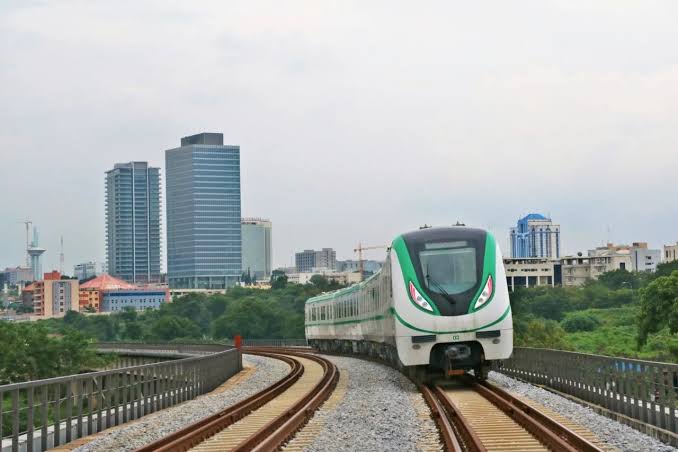
Residents along the Gwagwa-Airport railway corridor in the Federal Capital Territory (FCT) Tuesday raised concerns over the abandonment of critical components of the Abuja rail project by the China Civil Engineering Construction Corporation (CCECC) Nigeria Limited, warning that the prolonged delay has exposed public installations to vandalism.
A resident of Gwagwa, Abuja, Abubakar Rilwanu said work on the corridor had stalled for more than one year and five months, particularly the installation of power supply infrastructure and other essential components needed to for the railway stations.
Rilwanu said the situation was particularly disappointing because the Gwagwa-Airport axis hosts three of the 12 railway stations along the route from the Central Business District to the Nnamdi Azikiwe International Airport.
He noted that residents felt let down by the delay, especially at a time when the Federal Government and the FCT Administration were pursuing major road and rail infrastructure projects across the country and the territory.
“It beats our imagination that a critical segment involving railway stations would be left to rot,” he said.
According to him, the prolonged inactivity has also exposed installations along the corridor to vandalism, with valuable materials allegedly being removed from the sites.
“Residents have watched helplessly as critical materials are stripped away daily,” he said, urging the relevant authorities to call CCECC to order and ensure that they return to site.
Rilwanu argued that completing the project would deliver economic benefits, particularly by reducing the Federal Government’s expenditure on diesel to power the railway stations.
He said connecting the stations to the national grid would help eliminate or reduce reliance on diesel-powered generators.
The resident also questioned why a multinational construction company with an international reputation would leave a project of such importance unattended for an extended period.
“Such prolonged abandonment would not be tolerated against its own people in China,” he said.
He warned that failure to address the situation could undermine public confidence in the administration’s infrastructure drive, noting that the project was located in the nation’s capital.
“If a project can be abandoned in Abuja, the seat of power, one can only imagine what obtains in other parts of the country,” he said.
Another resident of the area, Ishaya Madaki, said he was shocked that the project stagnated for this long.
“For a government that is spending heavily for infrastructure development, I do not know why it is allowing this major project to stall. However, it does not send a good signal about this administration, especially as this is the nation’s capital,” he said.
Efforts to get the reaction of the company did not yield fruit. Calls to a designated public line for enquiries were not answered or returned by the time of going to press.