
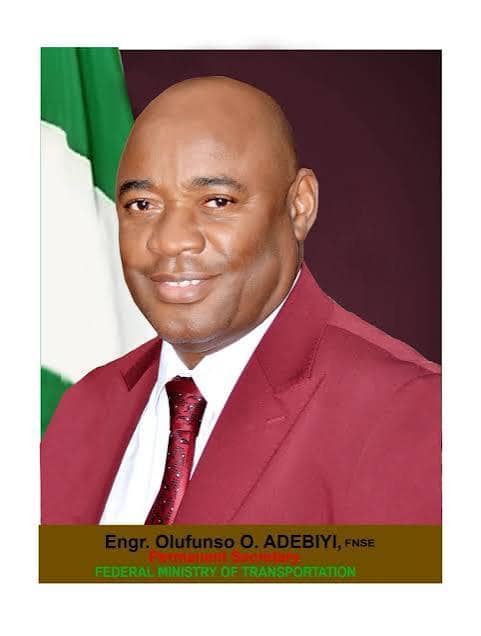
The federal government on Monday in Abuja, announced a series of landmark projects aimed at reducing Nigeria’s over-reliance on roads and building a more integrated transport system.
The updates were shared by the Permanent Secretary of the Federal Ministry of Transportation, Olufunso Adebiyi, at the opening of the 19th National Council on Transportation with the theme: “Developing an Effective Transport System for Nigeria: The Role of Integrated Transportation.”
Adebiyi called his presentation a “summary of summaries” of the administration’s work so far, noting that the focus is now on rail, water and air as viable alternatives to road transport.
He described the ongoing railway expansion as a rebirth of the sector, recalling when the Nigerian Railway Corporation (NRC) was one of the country’s strongest institutions, stating that the rail rebirth gathers pace.
Adebiyi outlined the completed and operational corridors to include: Port Harcourt–Aba, Warri–Itakpe, Lagos–Ibadan and Abuja–Kaduna, stating that work was also advancing on new routes.
He added: “The Kaduna–Zaria–Kano line is nearing completion and should open by December.
“The Kaduna–Daura–Katsina line is progressing, the Katsina–Jibia–Maradi link is targeted for next year, and work continues on Kano–Dutse.”
Adebiyi explained that beyond passengers, the government is pushing rail freight to take pressure off highways. Citing a recent case where a single train moved 33 forty-foot containers from the port to Ibadan Dry Port.
“Technically, you have removed 33 trailers from the Lagos-Ibadan Road,” he said.
Adebiyi added that more dry ports will help move containers closer to final destinations, cutting congestion, accidents and damage to roads.
Speaking on the Smart National Transport Data Bank, he explained that the Federal Executive Council (FEC) has approved a Smart National Transport Data Bank under a Design-Build-Finance-Operate-and-Transfer model.
The platform Adebiyi asserted would create a central database of drivers, vehicles, plate numbers and operators nationwide.
“It will also introduce standardised manifests at motor parks to record vehicle, driver, passenger and destination details.”
This, according to him, simply means that anytime a vehicle has an accident anywhere, ” you can pick the manifest and know who is inside and for what purpose and computerised plate numbers will also make it easier to track traffic violations.”
On the six standard bus terminals, he stressed that the government has approved six standardized bus terminals nationwide as a pilot.
Each terminal, Adebiyi revealed, would have uniform standards including waiting areas, passenger information systems, police posts, vehicle inspection bays, mechanic workshops, restaurants and restrooms.
Operators would need to meet safety and regulatory requirements, and licenses would attract sanctions for violations.
Continuing, he said plans were underway for a high-speed rail line from Lagos to Maiduguri with trains running up to 360km/h.
The goal, Adebiyi said, is to give Nigerians real choices between road, rail, air and water. “Light rail projects have also been approved for Lagos and Kano with plans to extend similar systems to other state capitals.
“In maritime, ongoing reconstruction and automation at the ports are expected to speed up cargo handling, reduce congestion and cut costs. The investments are also creating jobs.
“About 9,000 youths are currently engaged across two major projects, with roughly 4,000 on one and 5,000 on another.”
He also cited the new Federal University of Transportation as a move to build specialised manpower for the sector.