
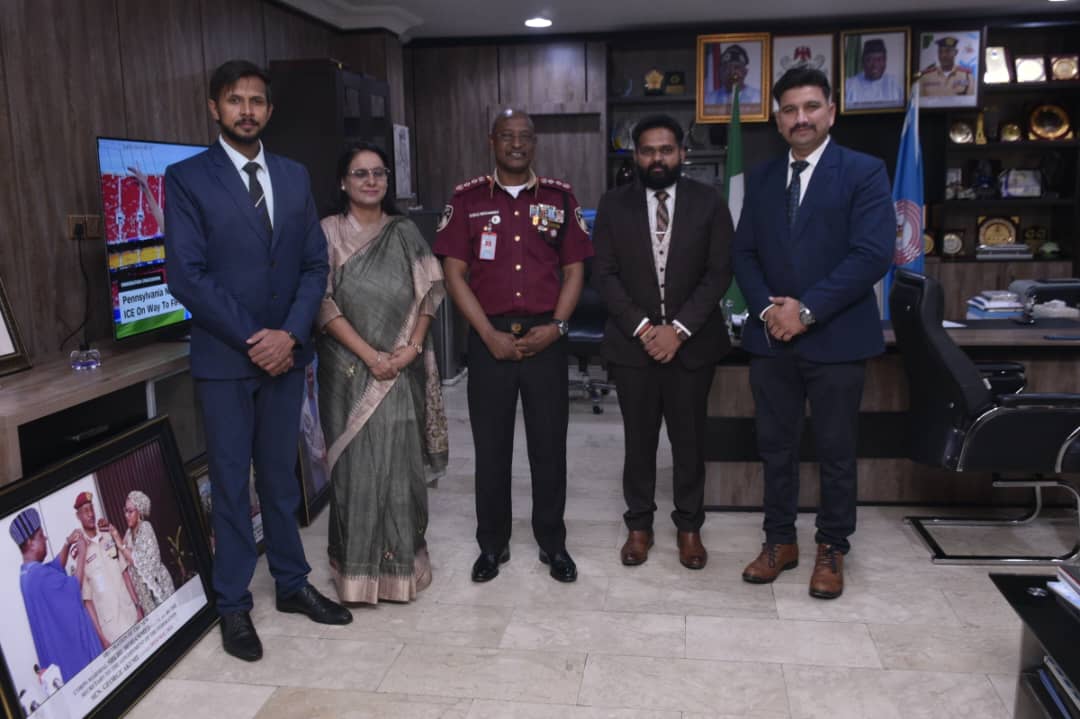
The Dean School of Behavioural Sciences and Forensic Investigation, Rashtriya Raksha University, India, Dr. Jasbirkaur Thadhani Monday assured the Federal Road Safety Corps (FRSC) and other security agencies of sustained collaboration in capacity building, technology transfer, and officer exchanges.
Speaking at the opening ceremony of the International Training Workshop on Stress Management and Emotional Well-being for Law Enforcement Officers in Abuja, he said the workshop marked the beginning of a broader partnership between India and Nigeria in security and law enforcement.
Thadhani asserted that stress management is central to the effectiveness of law enforcement and security services, and that the workshop was designed to equip officers with practical skills to manage occupational pressure.
She said Rashtriya Raksha University was committed to further collaborations with Nigeria in academics, officer exchanges, and the upskilling and reskilling of personnel.
Thadhani noted: “Our mandate covers specialised training in areas such as road safety, correctional administration, cyber security, and technology.”
She further explained that the University recently established a digital forensic laboratory in Mauritius and expressed optimism that similar technology-driven projects would be replicated in Nigeria.
According to her, The partnership would also include the setting up of training labs and continuous exchange of officers to enhance practical exposure and professionalism.
“This is not going to end here. We see this as the start of a long-term partnership that builds on the existing strong cultural and educational ties between India and Nigeria,” she added.
Also, the Corps Marshal of FRSC, Shehu Mohammed called on law enforcement officers in Nigeria to prioritise their mental and emotional well-being as a critical part of operational effectiveness.
Welcoming the High Commissioner of India to Nigeria, Abhishek Singh and facilitators from RRU, the Corps Marshal noted that the increasing exposure of officers to road crashes, emergencies, trauma, and security threats places enormous psychological strain on them.
According to him, While we have invested heavily in technical and operational training, experience shows that sustainable effectiveness also depends on the mental and emotional health of the men and women who protect lives and property,” he said.
Mohammed described stress management as a “strategic imperative” and said the FRSC’s partnership with the university, under a planned MoU, was aimed at aligning Nigeria’s capacity building with global best practices.
He urged participants to approach the training with openness, stressing that the knowledge gained must translate into improved professionalism, healthier work environments, and better service delivery to Nigerians.