

In a well orchestrated political game, the House of Representatives halted the quest by Hon. Ikeagno Ugochinyere to lead the minority caucus following the announcement of Hon. Fred Agbedi as the new leader.
The quest to fill the vacant position of the Minority Leader of the House of Representatives almost brought the image of the Green Chamber into disrepute when rumours filtered in that monies allegedly exchanged hands to pave the way for a member representing Ideato north/Ideato south federal constituency in Imo state, Hon. Ikeagno Ugochinyere to lead the minority caucus.
The position became vacant after Hon. Kingsley Chinda, lawmaker representing Obio/Akpor federal constituency, who vacated the role after emerging as the APC governorship candidate for Rivers state.
Against this background, 61 opposition lawmakers drawn from several opposition parties represented were said to have formally submitted Ugochinyere’s nomination to the Speaker, Hon. Tajudeen Abbas, for ratification and announcement in line with parliamentary procedures.
According to document made available to journalists on Wednesday, June 3,2026, 61 out of the 81 opposition members in the House signed the nomination, giving the Imo lawmaker overwhelming backing across party, regional and religious lines.
But, controversy subsequently trailed the endorsement of Ugochinyere when Deputy Spokesperson of the House and a member of the Labour Party (LP), Hon. Philip Agbese during the plenary on Thursday, June 4, 2026 denied endorsing the Action Peoples Party (APP) lawmaker to lead the minority caucus. He alleged that his signature was forged on the document nominating Ugochinyere for the role.
Nevertheless, Ugochinyere dismissed his claim as an “outrageous lie” and subsequently released a video to back his claim that Agbese signed the document endorsing him for the position of minority leader.
In a surprising move during the plenary last Wednesday, the House pulled the rug off the feet of Ugochinyere when it passed a resolution barring first time lawmakers from holding principal offices.
The Green Chamber adopted the resolution following the adoption of a motion sponsored by Hon. Babajimi Benson.
The resolution clarified Order 7, Rule 15 of the Standing Orders of the House. Order 7, Rule 15 of the Standing Orders of the green chamber states that “only members with cognate legislative experience as members of the house of representatives” shall be eligible for appointment as principal officers of the house.
Benson argued: “Global parliamentary best practices rule out first-term parliamentarians from holding principal offices and reserve principal offices for experienced legislators to promote institutional memory, deepen understanding of legislative processes, and enhance competence in constitutional interpretation and intergovernmental relations.”
Buttressing his argument, he cited the senate’s recent amendment to its rules restricting leadership positions to senators who have served at least two terms.
Benson stated: “The 10th senate has recently specifically defined ‘cognate legislative experience’ to mean ‘senators who have completed at least one full four-year term’, adding that those with multiple previous terms must have served in the immediate past assembly.’’
“There is a need to prioritise institutional memory, deepen parliamentary stability and continuity, build legislative experience, minimise avoidable turbulence, and promote mature representation in the comity of international parliamentary associations.”
The House unanimously adopted the motion when the Speaker, Hon. Tajudeen Abbas put it to a voice vote.
In a deft political maneuvering, the coup against Ugochinyere was completed on Thursday, June 11, 2026, the Speaker announced that Hon.Frederick Agbedi, representing Sagbama/Ekeremor Federal Constituency of Bayelsa State as emerged the Minority Leader.
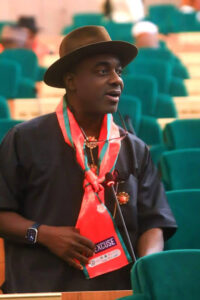
As conveyed by the Speaker, the Minority Caucus, acting in accordance with Order 7, Rule 15 of the Standing Orders of the House reached a consensus on the emergence of new Principal Officers.
Other officers of the minority caucus are: Hon. Abdussamad Dasuki (ADC, Sokoto) who emerged as the Deputy Minority Leader, Hon. Mansur Soro (APM, Bauchi), who is now the Minority Whip.
The Speaker said the nominations were duly arrived at through consensus among Members of the opposition caucus in line with established parliamentary procedure governing the emergence of Principal Officers of the House.
The reconstitution of the Minority Leadership followed changes in the composition of the Caucus arising from the resignation of Chinda, Deputy Minority Leader, Hon. Aliyu Madaki (Kano); and Minority Whip, Hon. Ali Isa J.C. (Gombe), who defected to the All Progressives Congress (APC).
Checks revealed that Dasuki, representing Kebbe/Tambuwal Federal Constituency of Sokoto State and was, prior to his appointment, Chairman of the House Committee on Shipping Services; while Soro, representing Darazo/Ganjuwa Federal Constituency of Bauchi State and was, prior to his appointment, Chairman of the House Committee on Small and Medium Enterprises (SMEs), Whereas Hon. George Ozodinobi (NDC, Anambra) retains his position as Deputy Minority Whip.
The Minority Caucus of the House comprises Members drawn from eleven political parties, namely: Accord Party, Action People’s Party (APP), African Democratic Congress (ADC), All Progressives Grand Alliance (APGA), Allied People’s Movement (APM), Labour Party (LP), New Nigeria People’s Party (NNPP), Nigeria Democratic Congress (NDC), Peoples Democratic Party (PDP), People’s Redemption Party (PRP), and the Social Democratic Party (SDP).
Political analysts were of the opinion that Ugochinyere deserved the political coup orchestrated against him considering his desperation to occupy the seat at all cost. They added that he went so low by releasing the video where Agbese was signing a paper — in which no one knows the content of the paper he signed.
A senior staff of the National Assembly who preferred anonymity said for Ugochinyere to have brought out the video, none of his colleagues will ever trust him again.
“He went so low. He was too desperate to occupy the position. He thought he could buy his way to power. Given that the minority caucus had been a sell out, Ugochinyere was seen as someone that could speak for them. He has been very vibrant on the floor. However, he is a first-timer,the House Rule cannot be sacrificed because eot his ambition. He doesn’t have the temperament and the maturity to occupy the position,” the source said.
In his submission, Hon. Ibrahim Sani, Special Assistant to Agbese, was of the opinion that the recent conduct of Ugochinyere raised serious concerns among many stakeholders about his suitability for the highly respected office of Minority Leader.
According to him, Leadership, particularly within a diverse opposition bloc, demands maturity, restraint, diplomacy, and a commitment to fostering unity among colleagues. Unfortunately, recent events suggest a departure from these principles.
Sani emphasised that the office of Minority Leader is not merely a position of influence; it is a symbol of collective representation for opposition parties in the National Assembly. He added that the occupant is expected to inspire confidence, build consensus, and accommodate divergent views within the caucus. When personal disagreements escalate into public confrontations and allegations, they risk eroding the trust necessary for effective leadership.
He noted: “At a time when Nigerians expect greater collaboration among elected representatives to address pressing national challenges, political actors should prioritize unity, respect for due process, and constructive engagement over public attacks and divisive rhetoric. The Minority Caucus requires leadership that can bring members together, not deepen existing fault lines.
“Ultimately, the controversy surrounding the Minority Leader position should be resolved through established parliamentary and party mechanisms, guided by transparency, fairness, and respect for democratic norms. The focus must remain on strengthening the institution of the National Assembly and ensuring that opposition voices effectively represent the interests of Nigerians.
“For many concerned stakeholders, the recent developments have reinforced the view that leadership positions should be occupied by individuals who demonstrate the temperament, inclusiveness, and statesmanship necessary to unite rather than divide. Whether Hon. Ugochinyere possesses those qualities is a question that recent events have brought increasingly into public scrutiny.”
If Ugochinyere has the dream of playing national politics or has a dream of vying for the position of the president in this country, he might as well kiss such a dream goodbye as he has shown thAt he cannot be trusted by his colleagues and comrades.