
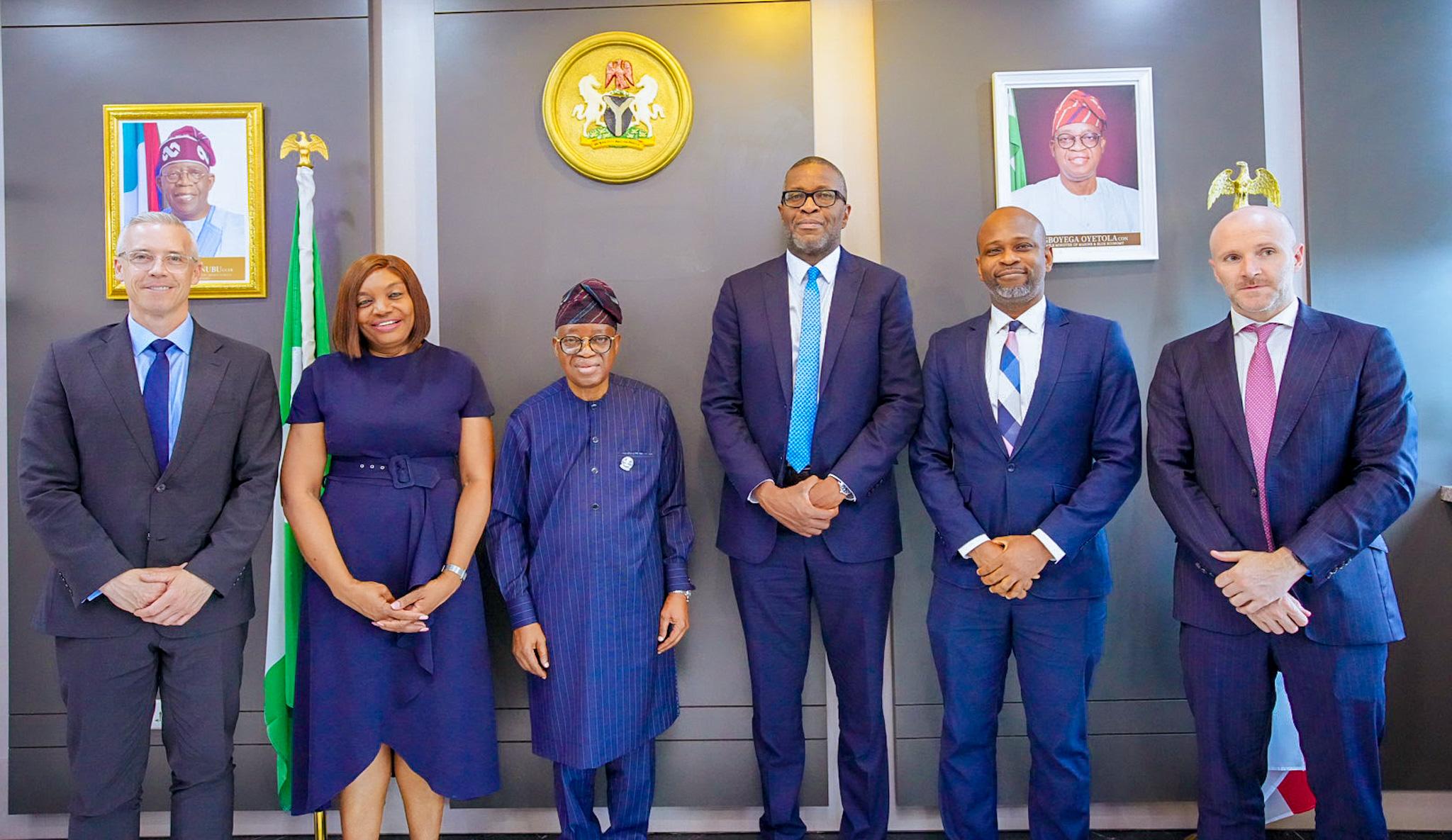
The Minister of Marine and Blue Economy, Adegboyega Oyetola Thursday reaffirmed that Nigeria is open for business, structural transformation, and strategic international partnerships capable of unlocking the vast potential of the nation’s marine and blue economy.
The minister made this known during a courtesy visit by a high-level delegation from Citibank, led by Akin Dawodu, Citibank’s Sub-Cluster and Banking Head for Sub-Saharan Africa (SSA), and Nneka Enwereji, Managing Director of Citibank Nigeria, at the Ministry’s headquarters in Abuja.
Oyetola underscored the federal government’s commitment to accelerating the development of Nigeria’s marine and blue economy as a key pillar of national economic diversification and sustainable growth.
He noted that Nigeria possesses immense maritime assets, including: 853-kilometre coastline, over 10,000 kilometres of inland waterways, and a 200-nautical-mile Exclusive Economic Zone (EEZ), all of which present significant opportunities for investment, job creation, trade expansion, and industrial development.
According to him, The administration of President Bola Ahmed Tinubu remains committed to implementing far-reaching reforms that will leverage these natural endowments to attract global capital, strengthen infrastructure, and drive inclusive economic prosperity.
Oyetola in a statement issued by Director, Information & Public Relations, Anastasia Ogbonna, noted that rehabilitation contracts have been awarded for the Eastern Ports—Port Harcourt, Warri, and Calabar—complementing the extensive modernisation already underway at the Western Ports of Apapa and TinCan Island.”
The minister further revealed that the federal government is facilitating the development of at least six deep sea port projects, including: Badagry, Ondo, Ibom, and Bonny, through Public-Private Partnership (PPP) arrangements.
Under this framework, sub-national governments are expected to drive commercial investments, while the federal government provides the enabling regulatory and licensing environment.
Beyond infrastructure development, Oyetola invited targeted investments in critical blue economy sectors, particularly fisheries, aquaculture and maritime security.
He observed that Nigeria currently produces approximately 1.4 million metric tonnes of fish annually, while national demand exceeds production by about 1.83 million metric tonnes.
This gap, he said, presents substantial investment opportunities across the fisheries value chain, including: sustainable aquaculture, fish processing, cold-chain logistics, and export-oriented production.
He encouraged Citibank to explore innovative financing mechanisms that could support the expansion of maritime surveillance capabilities and critical security assets needed to sustain and strengthen the country’s maritime security architecture.
Speaking on behalf of the delegation, Dawodu commended the Ministry’s bold vision and reform-driven agenda, expressing Citibank’s strong interest in supporting emerging opportunities within Nigeria’s marine and blue economy.
The delegation also indicated its willingness to deepen engagement with the Nigerian Maritime Administration and Safety Agency (NIMASA) on upcoming capital-intensive projects, building on recent interactions with leading global maritime stakeholders, such as the Mediterranean Shipping Company (MSC).