
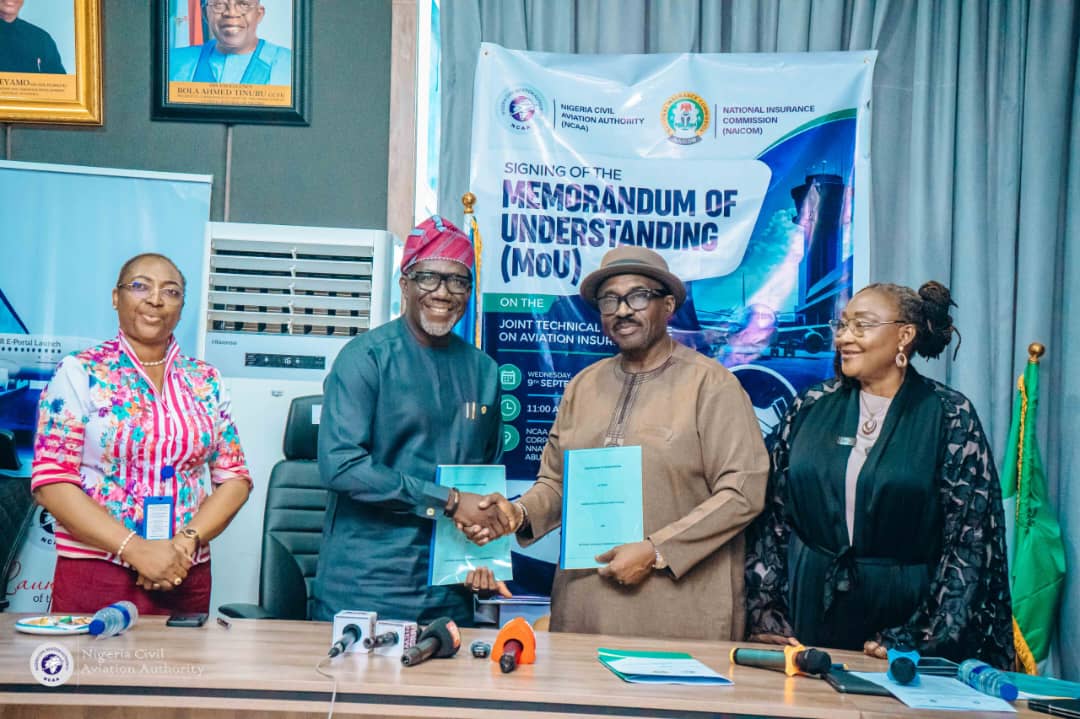
The Nigeria Civil Aviation Authority (NCAA) and the National Insurance Commission (NAICOM), Wednesday in Abuja, signed a Memorandum of Understanding (MoU) on cooperation and collaboration in the regulation and oversight of aviation insurance in Nigeria.
The MoU was signed by the Director-General, Civil Aviation, Capt. Chris Najomo, and the Commissioner for Insurance and Chief Executive Officer, Mr. Olusegun Omosehin.
Najomo said the epoch-making event culminated from a long-standing collaborative relationship between the two regulatory institutions.
He noted that the agreement reinforced a shared commitment to strengthening aviation safety, financial resilience, regulatory compliance, and the protection of the travelling public and other aviation stakeholders.
The MoU also gave birth to the formal establishment of a Joint Technical Committee on Aviation Insurance co-chaired by representatives from the NCAA and NAICOM.
Najomo noted that aviation remains a paradoxical industry that is globally recognised as the safest mode of transportation, yet characterised by high-impact operational risks.
He added: “As the Authority statutorily responsible for regulating and mitigating these risks at the State level, our safety mandate must be complemented by a robust, transparent, and verifiable insurance framework.
“This partnership with NAICOM strengthens that foundation and reinforces the operational safety and financial resilience of the Nigerian aviation sector.
“For several years, NCAA and NAICOM have worked closely, with NAICOM providing expert assessments on the adequacy and viability of insurance policies procured by aviation operators in compliance with Part 18.14 of the Nigeria Civil Aviation Regulations 2023.”
The MoU, he further said, deepens the cooperation, enhances stakeholder confidence, and supports cost-efficient operations while addressing challenges faced by Nigerian operators.
Speaking, Omosehin said given the nature of aviation operations; effective insurance protection is not merely a regulatory requirement; it is an essential risk management tool that safeguards the lives of travellers, the property, and the businesses within the broader economy.
He further stated it was imperative that regulators work together to ensure that insurance agreements supporting the aviation sector remain adequate, remain valid, and responsive to emerging risks.
Omosehin further explained that in the event of a serious accident in aviation, the level of protection that has been provided for people is resilient enough to put smiles on the faces of families of those who are affected, and businesses or entities that are also impacted.
“We are laying the foundation of what I call the stronger framework of cooperation that will ultimately benefit the aviation sector, that will benefit the insurance industry, and, overall, the Nigerian economy,” he noted.