
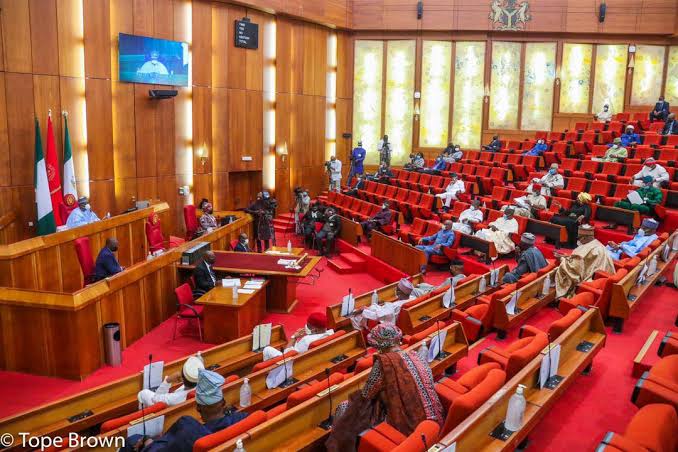
As part of efforts to address the escalating security issues in the country, the Senate Wednesday passed the Bill seeking to establish state police across the federation.
The legislation seeks to establish a state policing framework that would operate concurrently with the existing federal police system, effectively ending the exclusive control of policing by the federal government.
The passage followed a rigorous clause-by-clause consideration of the bill and came after more than two-thirds of senators voted in support through a manual voting process conducted on the floor of the chamber.
Leading the debate on the Bill, Senate Leader, Opeyemi Bamidele, urged senators to support what many lawmakers described as a critical reform aimed at strengthening internal security and improving response to local threats.
The bill empowers state governors to appoint Commissioners of Police for their respective states, subject to confirmation by the state Houses of Assembly.
Clause 17 of the Bill states that “while the Federal Police Service will continue to be headed by the Inspector-General of Police, each State Police Service shall be headed by a Commissioner of Police appointed by the governor and confirmed by the legislature of the state.”
Section 17(6) provides that “a governor may issue lawful written directives of a general policy nature to the Commissioner of Police on matters relating to the maintenance of public safety and public order within the state.”
To address concerns over potential abuse of the new policing structure by state governments, lawmakers included safeguards aimed at protecting political freedoms and civil liberties.
Section 17(7) specifically states that “a state Commissioner of Police shall not arrest, detain, investigate or deploy force against any person, political party or group merely for criticising the government except in accordance with the law.”
The Red Chamber approved the bill after considering the report of the Senate Committee on the Review of the Constitution, presented by Deputy Senate President and committee chairman, Barau Jibrin.
President of the Senate, Godswill Akpabio, announced the passage of the legislation after lawmakers overwhelmingly backed the proposal during plenary.