
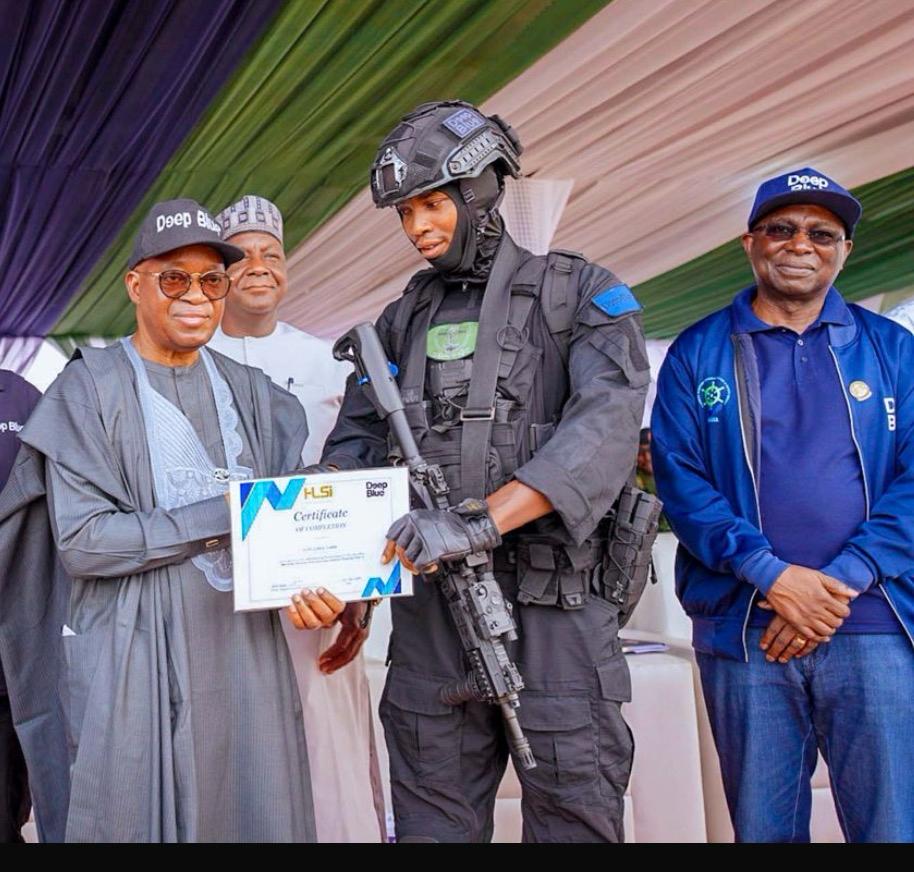
Not fewer than 492 Advanced Combat Personnel and Capability Presentation of the Deep Blue Project Task Group have graduated from the program held at the 5th Battalion Army Barracks in Elele, Rivers State.
This is as the government announced plans to expand the Deep Blue Project to vulnerable coastal and maritime corridors across the country, including the sensitive Bakassi axis, as part of efforts to further strengthen Nigeria’s maritime security architecture.
The Minister of Marine and Blue Economy, Adegboyega Oyetola, made the disclosure during the 2026 Graduation Ceremony.
Oyetola said the planned expansion would target critical coastal areas such as Bakassi Peninsula, Igbokoda and other vulnerable maritime corridors across the country.
According to him, The initiative is aimed at consolidating the gains already recorded under the Integrated National Security and Waterways Protection Infrastructure, popularly known as the Deep Blue Project.
He asserted that building on the significant strides already made, the Ministry of Marine and Blue Economy was currently evaluating strategic frameworks for the expansion of the Deep Blue Project to further strengthen the country’s maritime security architecture in critical coastal areas such as Igbokoda, Bakassi, and other vulnerable maritime corridors.
Oyetola explained that the move would further curtail maritime insecurity, enhance operational capacity, improve maintenance systems and ensure maritime security assets remain fully functional and effective in safeguarding Nigeria’s waters.
He stated that Nigeria had recorded zero piracy incidents within its territorial waters over the past four years due to the sustained implementation of the Deep Blue Project and collaboration among security agencies.
“Piracy incidents across the Gulf of Guinea had declined by more than 70 per cent within the same period,” the minister said.
He maintained that, prior to the establishment of the Deep Blue Project in 2021, the Gulf of Guinea had become one of the most dangerous maritime corridors globally, accounting for nearly 45 per cent of reported global piracy incidents and over 90 per cent of crew kidnappings at sea during peak periods.
Earlier, Director-General of the Nigerian Maritime Administration and Safety Agency, Dr. Dayo Mobereola described the event as a major demonstration of Nigeria’s operational readiness, institutional resilience, and determination to maintain a safe, secure, and economically viable maritime environment.
He said the graduates comprised 232 Maritime Security Unit operatives, 19 armoured vehicle drivers, 13 armoured vehicle mechanics, eight special mission helicopter pilots, eight helicopter technicians, five special mission aircraft pilots, six aircraft technicians.
Others are: 49 special mission vessel crew members, 28 interceptor boat mechanics, 62 interceptor boat drivers, 52 Command, Control, Communication, Computer and Intelligence (C4I) operators, and 10 Vertical Take-Off and Landing Unmanned Aerial Systems operators.