
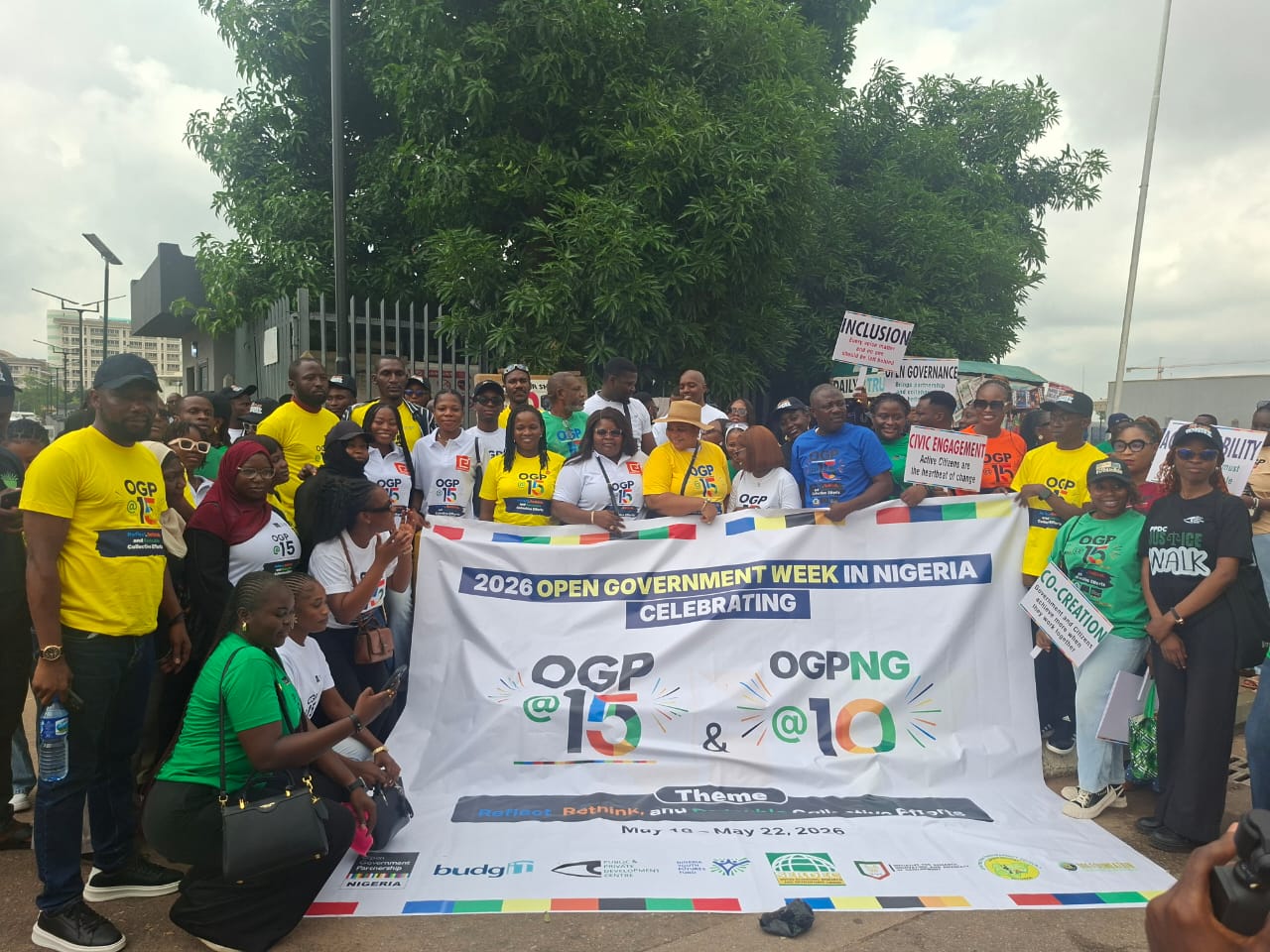
Open Government Partnership (OGP) coalition Wednesday urged President Bola Tinubu to sign and implement Nigeria’s Fourth National Action Plan (NAP 4) to ensure improved inclusive governance.
The coalition stated this in Abuja during activities marking the 2026 Open Government Week on Wednesday, in Abuja,where they stressed the need for government at all levels to uphold citizens’ rights to information and participation in governance.
Speaking, Community and Youth Engagement Coordinator at the Nigeria Youth Futures Fund (NYFF), Maimuna Sani said the federal government to work closely with young people and civil society groups in policy formulation and development planning.
Sani noted: “We are calling on the Nigerian government to consult young people on policies that affect them and to co-create development plans for a more equitable, transparent and accountable Nigeria.
“We are calling on the federal government to work closely with the civil society to ensure the implementation of the Fourth National Action Plan for Nigeria.
“We are also using this opportunity to call on Mr President to endorse the Open Government Partnership as it serves the country at large.”
“We have a national action plan four that has been drafted and presented to the president and we want the president to sign up for it.”
On his part, Civil Society Adviser at the OGP Nigeria Secretariat, Uchenna Arisukwu called on President Tinubu to demonstrate political will by approving the Fourth National Action Plan and ensuring adequate funding for its implementation.
He stated: “These commitments require strong government support and adequate funding,” he stated.
“When government is transparent, citizens can hold leaders accountable. That is why laws like the Freedom of Information Act are important,”
“The national action plan has 12 commitments across seven thematic areas, including procurement, budget transparency, asset recovery and open contracting.”
Arisukwu recalled that Nigeria’s OGP journey since 2016 had increased citizens’ participation in governance and improved public access to procurement and beneficial ownership information.
He added: “Today in Nigeria, we have the Nigeria Open Contracting Portal (NOCOPO), a portal that opens up the procurement system in Nigeria makes it a lot more transparent to know who is getting what, how did they get it, and all of that.
“Today, we have the beneficial ownership portal that is unmasking company ownership as a way of reducing corruption. Today in Nigeria, the freedom of information is being implemented a lot more, a lot of compliance and demand by citizens.
“All this came about because of Nigeria joining the OGP. Since 2016,we have done three national action plans, one, two, three.”
In his submission, Stakeholder Manager at the BudgIT Nigeria, Andrew Orlando said the essence of the OGP was to ensure that government remained open and accountable to citizens.
“We are calling on government to be transparent in its dealings because open government means citizens should have access to information about government activities and how they affect the people,” he said.
On her part, Faith Nwadishi of the Centre for Transparency Advocacy pointed to the Freedom of Information (FOI) Act and beneficial ownership reforms as some of the gains of Nigeria’s OGP participation.
She noted that the Supreme Court’s 2025 ruling compelling all tiers of government to implement the FOI Act had strengthened citizens’ access to information.